
Insights
I checked 139 fire sprinkler contractor websites. Here’s what I found.
By Shivam Singh ·
In brief
I checked the websites of 139 fire sprinkler contractors listed in public directories in the US, UK and Canada, and could analyze 95 of them. They were the most likely of the four trades I audited to name a certification (34%), but the least likely to mention a quote (21%). 65% had no Organization or LocalBusiness schema, 40% had no click-to-call link, and the main content took a median 6.3 seconds to appear on mobile.
What I measured
This is one part of a larger audit of 605 industrial websites across four trades, described in the main write-up. For fire sprinkler contractors, I took 139 firms from Yellow Pages in the US and Canada and, in the UK, the BAFSA member directory and the LPCB RedBook, in cities such as Houston, Dallas–Fort Worth, Phoenix, Chicago, Pittsburgh, Mississauga, Calgary, Edmonton, Birmingham, Manchester and Glasgow.
I checked each homepage once on November 16–17, 2026: contact routes, content, basic search setup, marketing tags, and one Google PageSpeed Insights mobile lab test. I haven’t worked for any sprinkler contractor. This is an outside look, not a client story.
Dead and unsafe sites
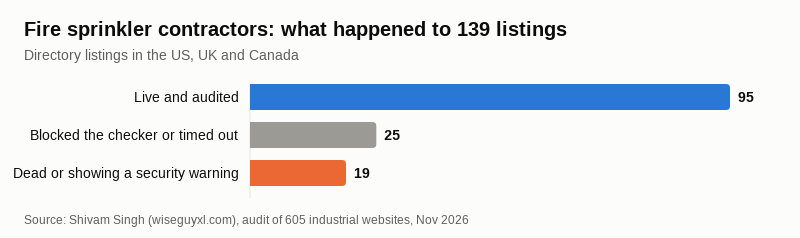
19 of the 139 listed websites were dead or unsafe: the domain no longer worked, the browser showed a security warning, or the server returned an error page. Some others blocked my checker or timed out, and I left those out rather than call them broken. That left 95 live sites.
For a fire protection business, a browser security warning is a particularly bad first impression. The buyer is a facility manager deciding who to trust with life safety equipment.
Sprinkler contractors against the full sample
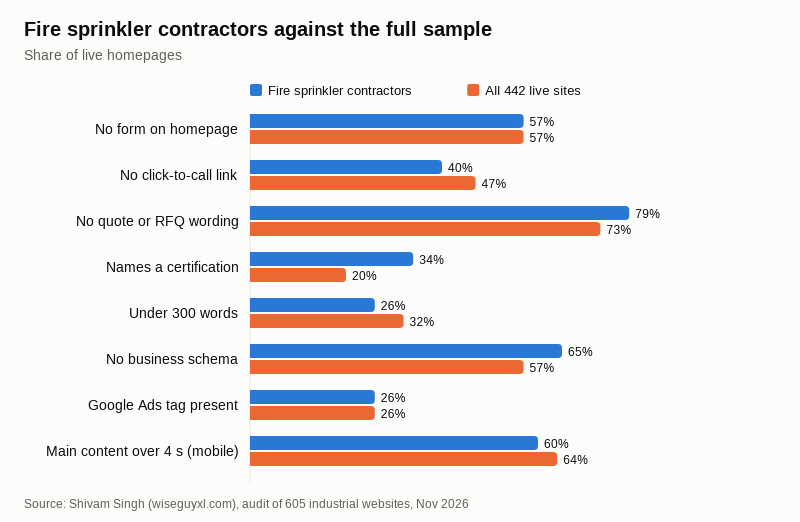
| Finding | Sprinkler (95) | All four trades (442) |
|---|---|---|
| No form on homepage | 57% | 57% |
| No click-to-call link | 40% | 47% |
| Mentions quote or RFQ | 21% | 27% |
| Names any certification | 34% | 20% |
| Under 300 words on homepage | 26% | 32% |
| No Organization or LocalBusiness schema | 65% | 57% |
| No meta description | 36% | 30% |
| No H1 | 27% | 28% |
| Google Ads tag present | 26% | 26% |
| Analytics (GA4 or Tag Manager) | 40% | 39% |
| Median mobile PageSpeed score | 68 | 67 |
| Mobile LCP over 4 seconds (lab) | 60% | 64% |
| Median homepage word count | 478 | Not calculated |
| Median mobile LCP (lab) | 6.3 s | Not calculated |
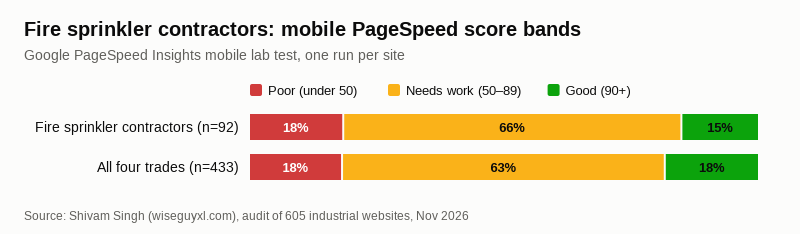
LCP (Largest Contentful Paint) is how long the main content of the page takes to appear. Of the sprinkler sites that returned a PageSpeed score, 17 scored poor (under 50), 61 needed work (50–89) and 14 scored good (90 or more).
What stands out
Sprinkler contractors name certifications more than any other trade: 34% of homepages mention one. Of the 95 sites, 18 name NFPA, 7 name NICET and 7 name LPCB. Smaller numbers mention OSHA, ULC, FIRAS and BAFE.
They are the least likely to mention a quote: 21%. Part of that may be the work itself. Inspection and maintenance contracts aren’t always sold as a “quote”. But a facility manager looking for a new inspection contractor still needs an obvious way to ask for a price.
Search basics lag. 65% have no Organization or LocalBusiness schema, tied with CNC shops for the highest, and 36% have no meta description. For a trade that sells to a local area, schema with an address, phone number and service area is a cheap fix.
Contact routes are about average. 40% have no click-to-call link and at least 57% have no form on the homepage (my form check counts search boxes too, so the real figure is at least that high).
Speed sits near the middle: a median score of 68, with a median of 6.3 seconds for the main content to appear and 60% over the 4-second line that Google treats as poor.
What it means if you hire a sprinkler contractor
Sprinkler contractor websites are more likely than other industrial sites to tell you about certifications, which helps. But many still won’t tell you clearly whether they take on inspection contracts, what areas they cover or how to get a price. Expect to phone. Ask for license numbers, technician certifications and proof of insurance directly, whatever the website says.
For contractors, this is a gap you can use. A building owner or facility manager comparing inspection providers will lean toward the one whose website answers the basic questions. That’s the core of how I approach marketing for fire protection contractors.
What I’d fix on a sprinkler contractor’s website
- A dedicated inspection, testing and maintenance page (why inspection contracts should lead your marketing). In the US, say plainly that you inspect to NFPA 25, which sets the inspection, testing and maintenance requirements for water-based fire protection systems. In the UK, name the standard you maintain to, such as BS EN 12845.
- An inspection request form that asks for building type, rough size, system type and current contractor, with a click-to-call number next to it.
- Separate pages for new installation, retrofits and deficiency repairs, since each comes from a different buyer at a different time.
- Credentials in text: state contractor license numbers, NICET-certified technicians and NFPA membership in the US; LPCB certification and BAFSA membership in the UK.
- The towns and counties you cover, written out, not only a map.
- An emergency or impairment phone line, if you offer one, as a tap-to-call link at the top of every page.
- LocalBusiness schema with your address, phone number and service area, plus a meta description and one H1.
- Building types you work in (warehouses, offices, healthcare, residential blocks) with a line of detail on each.
Limits
I checked homepages only. The sample comes from directories, not a random draw, and the UK firms came mostly from association and certification lists. Lab speed scores vary from run to run, so I only report medians and bands, never single sites. I didn’t split results by country because some of those groups are too small.