
Insights
Paying for clicks with nowhere to send them
By Shivam Singh ·
In brief
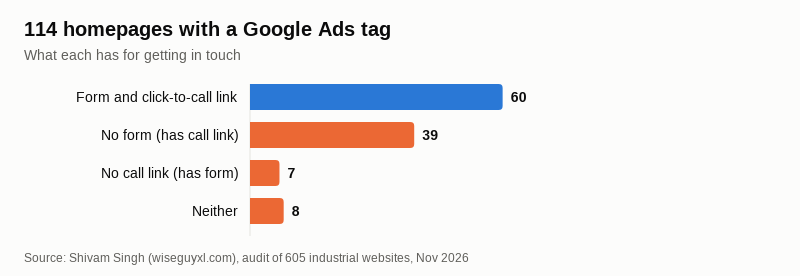
In my audit of 442 live industrial websites, 114 carried a Google Ads tag. 54 of those (47%) were missing a form, a click-to-call phone link or both on the homepage: 47 had no form, 15 had no phone link and 8 had neither. That doesn’t prove money is being wasted. The ads may point to a separate landing page, and a tag doesn’t prove a firm is spending today. But it’s worth checking if you’re one of them.
What I found
I audited the homepages of 605 industrial firms in the US, UK and Canada on November 16–17, 2026: CNC machine shops, sheet metal fabricators, forklift rental and repair firms, and fire sprinkler contractors. 442 sites were live and could be analyzed. The full method is in the main write-up.
One check looked for the Google Ads tag, the code Google Ads uses to record conversions or build remarketing lists. 114 of the 442 sites had it. I then looked at whether those same homepages gave a visitor an easy way to get in touch.
- 54 of the 114 (47%) lack a form or a click-to-call link on the homepage.
- 47 have no form of any kind.
- 15 have no click-to-call phone link.
- 8 have neither.
A click-to-call link is a phone number coded so that tapping it on a phone starts a call. My form check counts any <form> tag, including search boxes, so the number of tagged sites with no real contact form is at least 47.
I don’t have industrial clients yet and haven’t worked for any of these firms. This is what the pages show from the outside, not a client story.
By trade
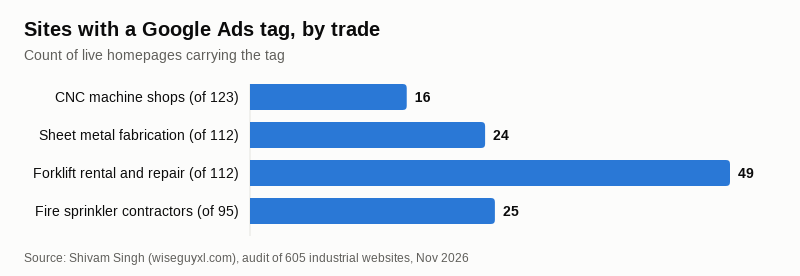
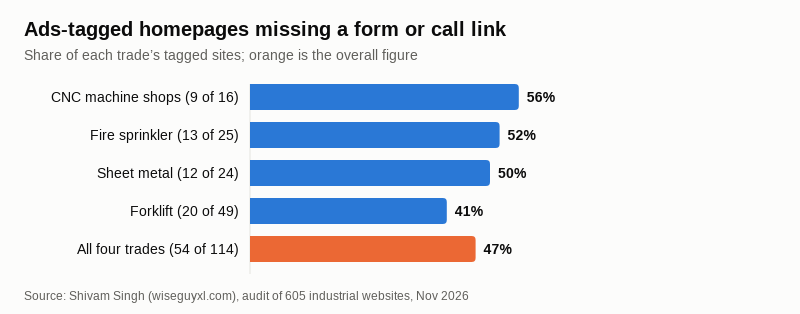
Here is how the 54 split by trade, next to how common the tag is in each.
| Trade | Live sites | Google Ads tag present | Of those, missing a form or call link |
|---|---|---|---|
| CNC machine shops | 123 | 16 (13%) | 9 of 16 |
| Sheet metal fabrication | 112 | 24 (21%) | 12 of 24 |
| Forklift rental and repair | 112 | 49 (44%) | 20 of 49 |
| Fire sprinkler contractors | 95 | 25 (26%) | 13 of 25 |
| All four trades | 442 | 114 (26%) | 54 of 114 |
Forklift firms carry the tag far more than anyone else, and they are also the best at click-to-call links, so a smaller share of their advertisers have the gap (20 of 49). CNC shops rarely carry the tag at all. Forklift firms also have the slowest pages in the sample, with a median 7.4 seconds for the main content to appear in a mobile lab test, which is a separate problem for anyone paying for clicks.
Why it matters
Each ad click costs money. If the click lands on a page where a buyer can’t quickly call or send a request, some of them will go back to the search results and click the next ad. On a phone, a tap-to-call link is the shortest route from interest to conversation. Without it, the buyer has to copy or remember the number.
There is also a measurement problem. Google Ads learns from conversions: form submissions and calls. If there is no form and no phone link on the page, there is less for the account to record. Automated bidding then has less to go on.
Two fair caveats
First, ads don’t have to point at the homepage. Many advertisers send paid traffic to a separate landing page built for the campaign, with its own form and phone number. I only checked homepages, so a firm in my 54 may have a perfectly good landing page that I never saw.
Second, the tag doesn’t prove active spending. It can be left over from an old campaign, added by a previous agency, or used only for remarketing lists. Some of these 114 firms may not be running ads at all today.
So the 54 isn’t a count of firms wasting money. It’s a count of firms where the homepage, the page most people see first, doesn’t make contact easy, despite a sign that ads have been or are being used.
How to check your own account
- In Google Ads, open the landing pages report and list every page your ads send people to.
- Open each one on your phone, not your desktop.
- Tap the phone number. If it doesn’t start a call, make it a click-to-call link.
- Find the form. Fill it in and make sure the message reaches someone who will reply.
- Check your conversion actions and confirm that form submissions and calls are both being recorded.
- If you no longer run ads, decide whether the tag should stay. It does no harm, but it’s worth knowing why it’s there.
What a good landing page for an industrial ad has
- A heading that matches the search: “CNC machining in Cleveland”, not just the company name.
- A click-to-call link at the top, visible without scrolling.
- A short form, with a file upload for drawings if you quote from drawings.
- Two or three lines on what you do and for whom, with the certifications that matter to the buyer named in text. Only 29% of CNC shop homepages do this.
- A page that loads quickly on a phone, with a small header image. Forklift dealer sites were the slowest in the sample.
- Conversion tracking on both the form and the phone link.
Limits
Homepages only. One pass on November 16–17, 2026. The sample comes from directories, not a random draw. The form check counts any <form> tag, so it understates missing contact forms. A Google Ads tag doesn’t prove current spending. I don’t report results for single firms or for trade and country together, because some of those groups are too small.