
Insights
I audited 605 industrial company websites in the US, UK and Canada
By Shivam Singh ·
In brief
I took 605 CNC machine shops, sheet metal fabricators, forklift rental and repair firms and fire sprinkler contractors from public directories in the US, UK and Canada, and checked each homepage on November 16–17, 2026. 76 of the listed websites (13%) were dead or showed a security warning. Of the 442 live sites I could analyze, 57% had no form on the homepage, 47% had no click-to-call phone link and only 20% named a certification. The median mobile PageSpeed score was 67 out of 100.
Why I did this
I want to do marketing for industrial firms. I don’t have an industrial client yet, so before I tell anyone what to fix, I wanted to see what websites in these trades actually look like. This is what I found looking from the outside. It isn’t a client story, and I haven’t worked for any of the firms in the sample.
I don’t name any of them either. The point is the pattern across hundreds of sites, not any one business.
How I did it
- Four trades: CNC machine shops, sheet metal fabrication, forklift rental and repair, and fire sprinkler contractors.
- Three countries: 317 firms in the US, 156 in Canada and 132 in the UK, 605 in total. I drew them from industrial cities in each country, such as Cleveland, Milwaukee, Houston, Mississauga, Hamilton, Calgary, Birmingham, Sheffield and Manchester.
- Public directories only: Yellow Pages in the US and Canada, Firmbase for UK manufacturers, the UK Material Handling Association (UKMHA) member list, the British Automatic Fire Sprinkler Association (BAFSA), the LPCB RedBook and chamber of commerce listings. I removed duplicates by website domain. I didn’t use Google Maps, so there is nothing here about reviews or ratings.
- Homepage only, plus robots.txt and the XML sitemap. One pass per site, one request at a time, and no forms submitted.
- Speed: one Google PageSpeed Insights mobile lab test per site.
- Dates: November 16–17, 2026.
- Tools: a Python script I wrote ran the checks and called the Google PageSpeed Insights API. I used AI tools to help analyze the data and draft this write-up. Every figure comes from the dataset, and I checked the numbers against it.
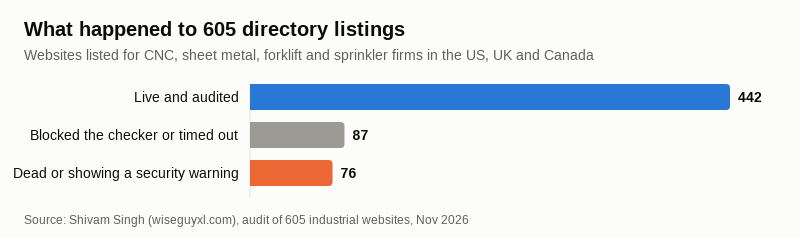
Not every listing led to a working website. 76 of the 605 (13%) were dead or unsafe, which I cover below. Another 87 blocked my checker (a 403 “forbidden” response) or timed out. I left those 87 out and I don’t count them as broken. Plenty of sites block automated visitors on purpose, and a real buyer with a browser may get through fine.
That leaves 442 live sites: 123 CNC shops, 112 sheet metal fabricators, 112 forklift firms and 95 sprinkler contractors. By country, 226 are in the US, 112 in the UK and 104 in Canada. All the percentages below are shares of those 442 unless I say otherwise.
What I measured, in plain words
- Contact form: whether the homepage has any form at all. My check counts any <form> tag, including search boxes and newsletter sign-ups, so the “no form” figure is a floor. The real share of homepages without a contact or quote form is at least that high.
- Click-to-call link: a phone number coded so that tapping it on a phone starts a call (a tel: link). A number shown as plain text doesn’t count.
- Quote or RFQ: whether the words “quote” or “RFQ” appear on the homepage.
- Certification: whether the page text names one, such as ISO 9001, AS9100, ITAR, NFPA, NICET, LPCB, BAFE or OSHA. A certification shown only as a logo image won’t be picked up.
- Schema: Organization or LocalBusiness structured data. This is code that tells search engines who the business is and how to reach it.
- Meta description and H1: the short summary a search engine may show under your link, and the main heading on the page.
- Google Ads tag: the code Google Ads uses to record conversions or build remarketing lists. Having it doesn’t prove a firm is spending money on ads right now.
- Analytics: Google Analytics 4 or Google Tag Manager on the page.
- PageSpeed score: Google’s 0–100 lab score for mobile. Under 50 is poor, 50–89 needs work and 90 or more is good.
- LCP (Largest Contentful Paint): how long the main content of the page takes to appear. Google treats anything over 4 seconds as poor.
The headline findings
- 76 of 605 listed websites (13%) were dead or unsafe. 36 domains no longer resolve, 22 show a browser security warning (16 certificate name mismatches, 4 expired certificates and 2 self-signed) and 18 return an error page (404 or 5xx).
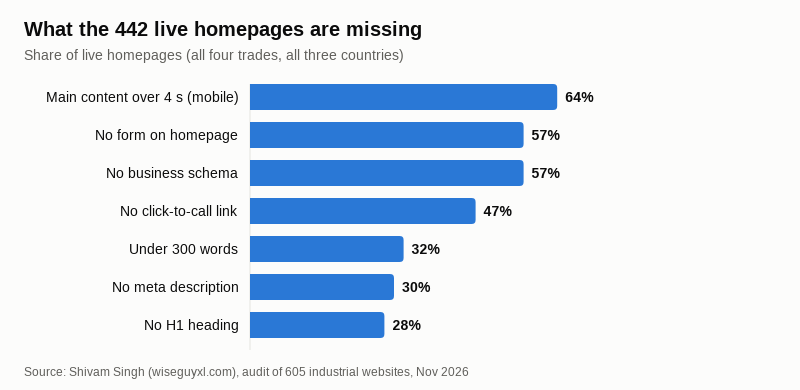
- 57% of live homepages have no form of any kind, and 47% have no click-to-call link.
- Only 27% mention a quote or RFQ on the homepage.
- Only 20% name any certification.
- 32% have fewer than 300 words on the homepage.
- 57% have no Organization or LocalBusiness schema, 30% have no meta description and 28% have no H1.
- 26% carry a Google Ads tag and 39% have analytics. Only 3% have a Meta pixel and 2% a live chat widget.
- The median mobile PageSpeed score is 67, and 64% take more than 4 seconds to show their main content in the lab test.
The dead sites are the part I’d call urgent, because most industrial buyers look a supplier up online before they get in touch. Directory listings tend to outlive websites. A buyer who clicks through to a domain that doesn’t load, or to a full-page browser warning, has no reason to try again. They have a list of other names right there.
The contact gaps come next. Nearly half the live sites don’t let a phone user tap to call, and more than half have no form at all on the homepage. A buyer can still find the contact page, but every extra step loses some of them.
Results by trade
| Finding | All (442) | CNC (123) | Sheet metal (112) | Forklift (112) | Sprinkler (95) |
|---|---|---|---|---|---|
| No form on homepage | 57% | 61% | 59% | 50% | 57% |
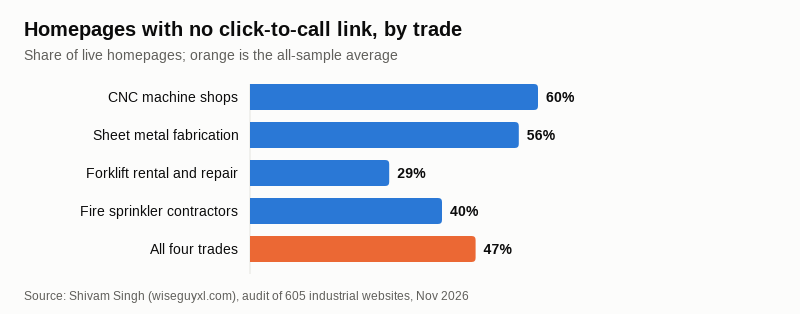
| No click-to-call link | 47% | 60% | 56% | 29% | 40% |
| Mentions quote or RFQ | 27% | 28% | 33% | 23% | 21% |
| Names any certification | 20% | 29% | 11% | 9% | 34% |
| Under 300 words on homepage | 32% | 46% | 37% | 16% | 26% |
| No Organization or LocalBusiness schema | 57% | 65% | 54% | 44% | 65% |
| No meta description | 30% | 37% | 29% | 21% | 36% |
| No H1 | 28% | 34% | 31% | 19% | 27% |
| Google Ads tag present | 26% | 13% | 21% | 44% | 26% |
| Analytics (GA4 or Tag Manager) | 39% | 24% | 30% | 63% | 40% |
| Median mobile PageSpeed score | 67 | 72 | 67 | 59 | 68 |
| Mobile LCP over 4 seconds (lab) | 64% | 56% | 68% | 73% | 60% |
| Median homepage word count | Not calculated | 326 | 423 | 708 | 478 |
| Median mobile LCP (lab) | Not calculated | 4.8 s | 6.0 s | 7.4 s | 6.3 s |
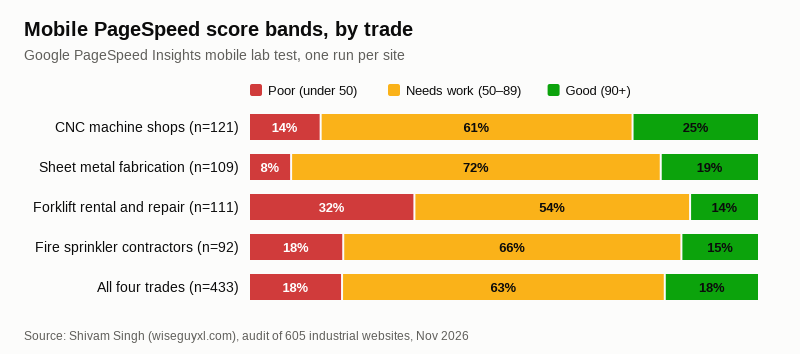
| PageSpeed sites scoring poor / needs work / good | Not calculated | 17 / 74 / 30 | 9 / 79 / 21 | 36 / 60 / 15 | 17 / 61 / 14 |
| Dead or unsafe (of all listed) | 76 of 605 | 21 of 166 | 18 of 150 | 17 of 150 | 19 of 139 |
A few sites didn’t return a PageSpeed score, which is why the score bands add up to slightly less than the live count for each trade.
Forklift firms are the most marketing-active group by a distance: 44% carry a Google Ads tag and 63% have analytics. They also do best on the basics, with the fewest missing phone links, H1s and meta descriptions. But they have the slowest sites. Their median score is 59, 36 of them score in the poor band, and the median time for the main content to appear is 7.4 seconds.
CNC shops are the opposite. Their homepages are the thinnest (a median of 326 words, with 46% under 300) and the least likely to have a phone link, Ads tag or analytics. They are also the fastest, with a median score of 72.
Sprinkler contractors and CNC shops are the most likely to name a certification. Sheet metal fabricators mention quotes most often but name certifications rarely. Each trade has its own write-up: CNC machine shops, sheet metal fabricators, forklift firms and fire sprinkler contractors.
Results by country
| Finding | US (226) | UK (112) | Canada (104) |
|---|---|---|---|
| HTTPS | 88% | 97% | 84% |
| Under 300 words on homepage | 37% | 14% | 40% |
| No Organization schema | 52% | 53% | 71% |
| No contact form | 58% | 50% | 61% |
| Analytics | 42% | 40% | 30% |
| Median mobile PageSpeed score | 71 | 62 | 67 |
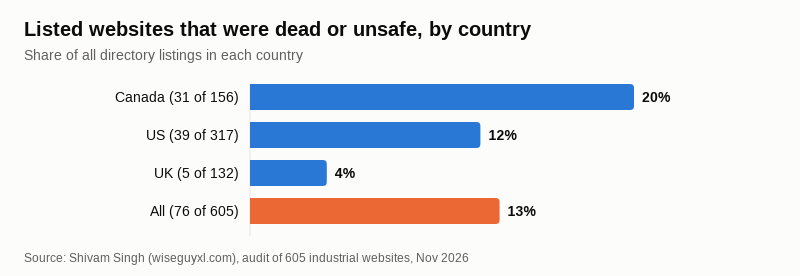
| Dead or unsafe (of all listed) | 39 of 317 | 5 of 132 | 31 of 156 |
UK sites are the most likely to use HTTPS and the least likely to have a thin homepage, but they have the lowest median speed score. Canadian sites are the most likely to lack schema and analytics, and the most likely to be thin.
The dead-site gap is the biggest difference. Only 5 of 132 UK listings were dead or unsafe, against 39 of 317 in the US and 31 of 156 in Canada. My guess is that this is partly about the sources. Many of the UK firms came from trade association member lists, which get pruned when members leave. The US and Canadian firms came mostly from Yellow Pages, which can keep old listings for years. I can’t prove that from this data.
I haven’t split the results by trade and country together. Some of those groups have fewer than 25 sites, which is too small to say anything useful.
Other things that turned up
- Of 251 sites that show a copyright year, 34 show 2023 or earlier.
- 22 sites have an SSL certificate that expires within 30 days. If it isn’t renewed, visitors will see the same browser warning as the 22 sites that already show one.
- Website platforms: WordPress 206, Wix 38, GoDaddy 26, Squarespace 15, Duda 12, and 129 I couldn’t identify.
- Certifications named across the whole sample: ISO 9001 (47 sites), NFPA (18), OSHA (14), AS9100 (10), NICET (7), LPCB (7) and ITAR (4).
An old copyright year doesn’t break anything. But a buyer who notices it may wonder whether the business is still running, and that’s a doubt you don’t need.
What this audit doesn’t tell you
- I only checked homepages. A firm may have a good quote form on its contact page or a phone link in the footer of another page. My figures describe the first page a buyer usually lands on, not the whole site.
- The “no form” figure counts any <form> tag, including search boxes, so it understates the real gap.
- The sample comes from directories, not a random draw. Firms that list themselves in directories may differ from those that don’t.
- Lab speed scores vary from run to run, and I ran each site once. That’s why I only report medians and bands across many sites and never a score for a single site. A lab test is also not the same as what real visitors experience.
- A Google Ads tag shows the code is on the page. It doesn’t show whether the firm is running ads today or how much it spends.
- This is a snapshot from two days in November 2026. Sites change.
What I’d fix first
If you run one of these businesses, this is the order I’d work in. None of it needs a redesign.
- Open your own website on a phone. Check that it loads and shows no security warning. Then check the website address on every directory listing you have, because those are where many buyers click from.
- Set your SSL certificate to renew automatically, and make sure the certificate covers both the www and non-www versions of your domain.
- Make your phone number a click-to-call link everywhere it appears.
- Put a short contact or quote form on the homepage, or a clear button that goes straight to one.
- Say what you do in words: services, processes, materials, equipment, the area you cover and the industries you work for.
- Name your certifications in text, not only as logos.
- Add one clear H1, a meta description and Organization or LocalBusiness schema. These are the basics of technical SEO.
- Shrink the large image at the top of the homepage. It is often the main content that the LCP measure is waiting for, and usually the quickest website speed fix.
- If you pay for Google Ads, check that every page your ads send people to has a form and a click-to-call link. 54 of the 114 tagged homepages in this audit didn’t, which I cover in paying for clicks with nowhere to send them.
- Install analytics, so you can see whether any of the above made a difference.
I’ve written separate pieces for each trade with fixes specific to it, and one on sites that carry a Google Ads tag but have no form or phone link. They’re linked below.