
Insights
Forklift dealer websites: the most marketing, the slowest pages
By Shivam Singh ·
In brief
I checked the websites of 150 forklift rental, sales and repair firms listed in the US, UK and Canada, and could analyze 112 of them. They were the most marketing-active of the four trades I audited: 49 carried a Google Ads tag and 63% had analytics. They also had the best basics. But they were the slowest, with a median mobile PageSpeed score of 59, 36 sites in the poor band, and a median 7.4 seconds for the main content to appear.
What I measured
This is one part of a larger audit of 605 industrial websites across four trades, described in the main write-up. For forklift rental and repair, I took 150 firms from Yellow Pages in the US and Canada and the UK Material Handling Association (UKMHA) member list, in cities such as Chicago, Dallas–Fort Worth, Detroit, Houston, Phoenix, Mississauga, Calgary, Manchester, Birmingham, Leeds and Bristol.
I checked each homepage once on November 16–17, 2026: contact routes, content, basic search setup, marketing tags, and one Google PageSpeed Insights mobile lab test. I haven’t worked for any forklift company. This is what I saw from the outside.
Dead and unsafe sites
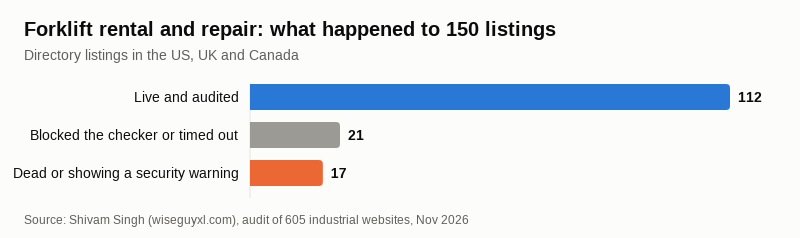
17 of the 150 listed websites were dead or unsafe: the domain no longer worked, the browser showed a security warning, or the server returned an error page. Some others blocked my checker or timed out, and I left those out rather than call them broken. That left 112 live sites.
Forklift firms against the full sample
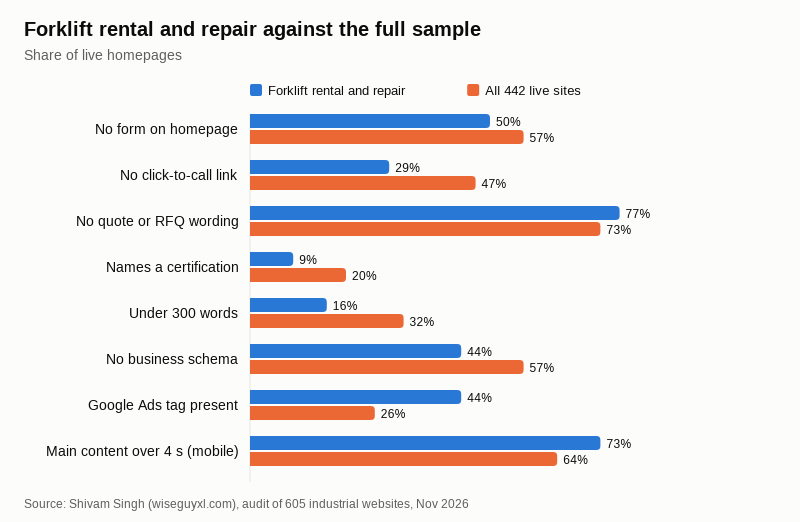
| Finding | Forklift (112) | All four trades (442) |
|---|---|---|
| No form on homepage | 50% | 57% |
| No click-to-call link | 29% | 47% |
| Mentions quote or RFQ | 23% | 27% |
| Names any certification | 9% | 20% |
| Under 300 words on homepage | 16% | 32% |
| No Organization or LocalBusiness schema | 44% | 57% |
| No meta description | 21% | 30% |
| No H1 | 19% | 28% |
| Google Ads tag present | 44% | 26% |
| Analytics (GA4 or Tag Manager) | 63% | 39% |
| Median mobile PageSpeed score | 59 | 67 |
| Mobile LCP over 4 seconds (lab) | 73% | 64% |
| Median homepage word count | 708 | Not calculated |
| Median mobile LCP (lab) | 7.4 s | Not calculated |
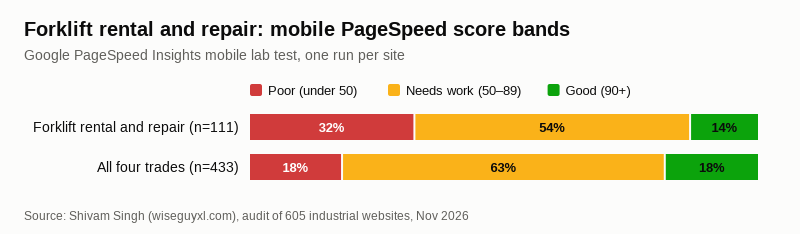
LCP (Largest Contentful Paint) is how long the main content of the page takes to appear. Of the forklift sites that returned a PageSpeed score, 36 scored poor (under 50), 60 needed work (50–89) and 15 scored good (90 or more).
What stands out
Forklift firms do the basics better than the other three trades. Only 29% lack a click-to-call link, against 47% across the sample. Only 16% have under 300 words on the homepage, and the median homepage runs to 708 words. They’re the least likely to be missing schema, a meta description or an H1.
They’re also the most active marketers. 49 of the 112 carry a Google Ads tag (44%) and 63% have analytics. Both are the highest of the four trades.
And they have the slowest sites. The median mobile score is 59, the lowest of the four. 36 sites score in the poor band, more than double any other trade. 73% take over 4 seconds to show their main content, and the median is 7.4 seconds. Google treats anything over 4 seconds as poor.
I didn’t measure page weight, so I can’t say exactly why. My guess is that dealer homepages carry more: equipment photos, sliders, inventory feeds and manufacturer content. That’s a guess, not a finding.
Certifications are almost never named: 9% of homepages, the lowest of the four trades. That’s less surprising here than for machine shops, since buyers of a forklift rental care more about availability and price than a quality certificate.
What it means if you rent or service forklifts
If you need a truck or a repair quickly, forklift websites are easier to act on than most industrial sites. A tap-to-call number is usually there. Expect pages to be slow on a phone, though, especially away from good signal, and don’t give up on a supplier because the first page took a while.
For dealers, the speed finding matters more than it would in other trades, because so many of you pay for traffic. When 44% of firms carry a Google Ads tag and the median page takes 7.4 seconds to show its main content in the lab test, some of that paid traffic is likely leaving before the page appears. Making the page faster is a cheaper fix than buying more clicks. Speed and landing pages are where I’d start with marketing for forklift dealers.
What I’d fix on a forklift dealer’s website
- Separate pages for rental, new and used sales, service and repair, and parts. Each is a different buyer with a different question, and each page should have its own phone link and form. I looked at search demand for forklift rental and repair separately.
- On the rental page: truck types, lift capacities, fuel types (electric, LPG, diesel), rental terms (daily, weekly, monthly, long-term) and your delivery area.
- On the service page: planned maintenance, breakdown call-outs, mobile service area, the makes you work on and how fast you usually respond.
- On the parts page: the brands you stock and how to send a part number or photo for a quote.
- If you offer operator training, say what it covers and what standard it meets, such as OSHA 1910.178 in the US. In the UK, a page on LOLER thorough examinations answers a question many site managers search for.
- Shrink and compress the large image at the top of the homepage, and load equipment galleries and inventory only when someone scrolls to them. It’s usually the quickest website speed win.
- Point paid ads at fast, focused landing pages for rental or service rather than at a heavy homepage.
- Check that your analytics record calls and form submissions as conversions, not just page views.
Limits
I checked homepages only. The sample comes from directories, not a random draw. A Google Ads tag shows the code is on the page, not that a firm is spending today. Lab speed scores vary from run to run, so I only report medians and bands, never single sites. I didn’t split results by country because some of those groups are too small.